Blog by Screen Printing Vancouver, 1065 Main Street, Vancouver, BC | Last updated: September 2026
Most trade show booths run on seven printed pieces: brochures, business cards, a retractable banner, flyers, a product or service catalogue, postcards, and booth signage such as table covers and display cards. Screen Printing Vancouver produces all seven in one place at 1065 Main Street near Main Street–Science World, so a booth kit can be colour-matched across materials instead of arriving from four separate suppliers.
If you already know what you need send us your show date, booth dimensions, and a list of what you plan to hand out, and we can confirm what is realistic to produce in time.
Submit your details here and request a free quote
What Screen Printing Vancouver Suggest You Should Have in Your Trade Show Booth Print Kit?
| Printed material | What it does at the booth | What usually drives the print decision |
| Brochure | Explains your services to someone who asked a real question | Fold type, page count, paper weight |
| Business cards | Keeps the conversation going after the show | Stock thickness, finish, quantity |
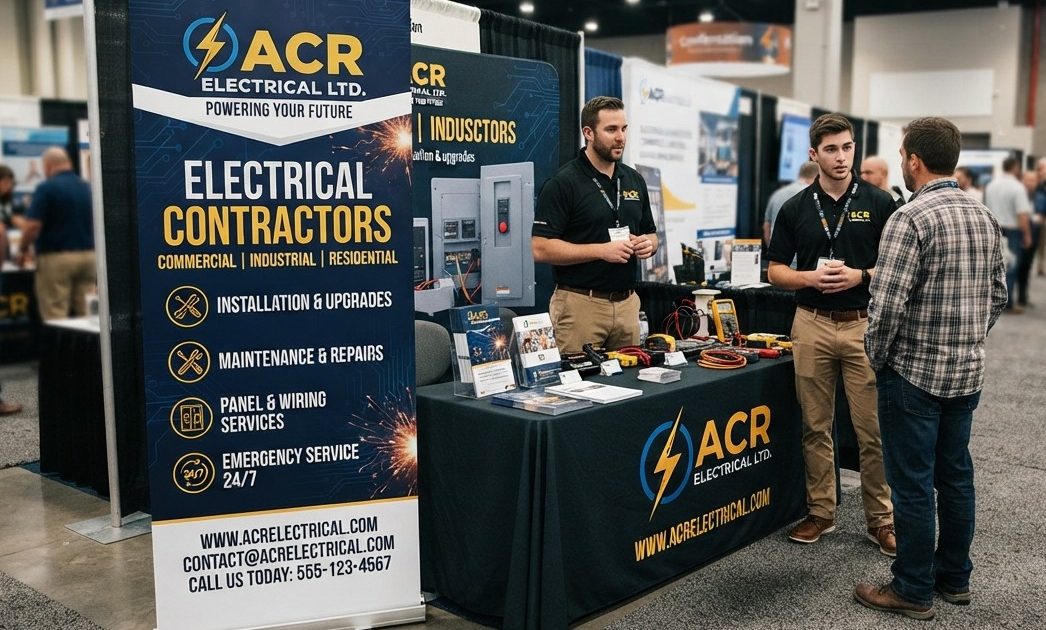
| Retractable banner | Pulls people in from across the aisle | Stand size, safe zones, headline legibility |
| Flyers | Carries one offer or one announcement | Volume, turnaround, single-sided or double |
| Catalogue | Serves as a reference piece after the show | Page count, binding, image quality |
| Postcards | Works as a takeaway and as follow-up mail | Stock, mailing requirements, quantity |
| Booth signage and table covers | Sets up the booth environment itself | Table size, fabric type, drape allowance |
Which of these you need depends on the show, your booth size, and whether you are selling a product line or a service. A flooring supplier and a general contractor at the same event often need very different kits. You can get in touch with us to discuss about what printed materials can help to uplift your booth experience.
Call us at 604-558-1877 or send us an email at iidowntown@gmail.com for any inquiries.
Why Do Printed Materials Still Matter at Trade Shows?
Trade show floors are busy and crowded with information, so something a visitor can hold and review later tends to outlast a conversation. A printed piece also carries your brand past the venue doors, which is useful at events where attendees see dozens of booths in an afternoon.
At Vancouver events such as the Interior Design Show or the Vancouver Fall Home Show, many attendees will be actively shortlisting professionals to hire. A printed takeaway can be the difference between a warm lead following up and forgetting your business name by the time they reach the parkade.
This does not mean print replaces digital follow-up. In most cases the two work together, and the printed piece is what triggers the visitor to look you up later.
What Should a Trade Show Brochure Include?
A brochure is usually your most flexible piece, because it has room to explain your process, your specializations, and how you work with clients. For a builder that might mean the construction sequence, and for an interior designer it might mean the design philosophy and scope of work.
When planning a brochure for a design-focused audience, three things tend to matter most:
- Image quality. Use high-resolution photography of your own work. Images pulled from a website or generated by AI tools are often too low in resolution to print cleanly at full size.
- Focused messaging. Concise, benefit-led copy usually reads better on a show floor than dense paragraphs.
- A clear next step. Point the reader toward one action, whether that is a consultation booking page or a phone number.
Fold choice affects both cost and how the content is read. A tri-fold works well for a short service overview, while a bi-fold gives larger image panels for portfolio work. We can talk through the options on our brochure printing page.
Do Business Cards Still Matter at Trade Shows?
Business cards remain one of the more practical tools at a booth because they are immediate, portable, and easy to hand over at the end of a conversation. They also fit in a pocket, which matters when an attendee is already carrying a bag of brochures.
A few decisions affect how the card performs:
- Design consistency. Matching fonts, colours, and logo placement across your card, banner, and brochure reinforces the same brand impression.
- Complete contact details. Name, title, phone, email, and website cover most cases. Adding a QR code to a portfolio page can save the reader typing.
- Stock and finish. Options such as matte lamination, spot UV, soft touch, or thicker stock change how the card feels in the hand. Heavier stocks generally cost more per card, so it is worth weighing that against your print run.
There is no single right answer here. A premium finish may be worth it for a small run of cards you hand out selectively, while a standard stock often makes more sense for high-volume distribution. Stock and finish options are listed on our business card printing page.
What Makes a Retractable Banner Work on a Show Floor?
A retractable banner is often the first thing an attendee reads, usually from several metres away and at an angle. That viewing distance should drive the design more than anything else.
Practical points that come up regularly:
- Headline size. A common rule of thumb is roughly one inch of letter height for every ten feet of viewing distance. A headline meant to be read across an aisle needs to be considerably larger than it looks on a laptop screen.
- Safe zones. The bottom few inches of the graphic sit inside the cassette and the very top sits behind the rail, so keep logos and contact details out of both areas.
- Eye-level content. The strongest message usually belongs roughly between waist and eye height, since the top of a tall banner is often blocked by people standing in front of it.
- Resolution at scale. Large format artwork is frequently built at a reduced scale with proportional resolution. Because banners are viewed from a distance, they typically do not need the 300 dpi you would use for a business card.
Retractable stands are also light and quick to set up, which helps if you exhibit at several Vancouver shows through the year. Send us your artwork along with the stand size you are using and we can flag any safe-zone issues before printing on our roll-up banner printing page. For a full back wall rather than a single stand, trade show banners and backdrops and step and repeat backdrops cover larger formats.
When Should You Hand Out a Flyer Instead of a Brochure?
A flyer generally suits one message: a show-only promotion, a new service, or a seasonal offer. A brochure suits the visitor who has already asked a detailed question and wants the full picture.
Flyers are usually the more economical option at volume, which makes them practical for entrance tables, attendee bags, and passing traffic. Keep the layout clean and the message singular, since a crowded flyer is more likely to be set down than read.
If your offer is time-sensitive, state the end date plainly rather than implying urgency. Quantities and stock options are on our flyer printing page.
Is a Printed Catalogue Worth It for Your Booth?
A catalogue makes sense when you carry a range of products or finishes that a visitor will want to compare later, such as flooring samples, lighting lines, or fixture options. For a single-service trade business, a brochure usually covers the same ground at lower cost.
If a catalogue does fit, a few things affect how well it holds up:
- Layout and organization. Group offerings logically so a reader can find a product without your help.
- Current information. Discontinued items and outdated pricing create follow-up problems, so check content before reprinting.
- Paper stock. Heavier stock feels more substantial, though it also raises cost and shipping weight if you are carrying boxes to a venue.
One operational note worth planning for: catalogues are expensive to reprint, so it is often better to leave volatile details such as pricing out of the printed piece and put them on an insert or a landing page instead. Multi-page pieces and bound documents are covered on our manual and booklet printing page, when you want to combine sheets on the spot.
How Do Postcards Help You Follow Up After the Show?
Postcards serve two purposes. They work as a compact takeaway at the booth, and they work as follow-up mail to the leads you collected, which is useful because the message is visible without being opened.
They are also easier for an attendee to carry than a folded brochure, so they often survive the walk back to the car. A project image on one side and a specific next step on the reverse tends to be the most useful format.
If you plan to mail them, confirm the finished size and addressing area before printing, since Canada Post has size and thickness requirements that affect postage. Size options are listed on our postcard printing page.
What Booth Signage and Table Displays Do You Need?
Booth signage covers everything that builds the physical space: table covers, header signs, directional signage, and small display cards next to samples. Together they do the work of explaining your booth before anyone speaks to you.
Common elements worth budgeting for:
- Table covers. Measure the table the venue supplies rather than assuming a standard size, and allow for the drape over the front edge. Logos placed low on the front panel are often hidden behind chairs and boxes.
- Product display cards. Small printed cards beside samples answer basic questions when you are busy with another visitor.
- Directional signage. Useful for larger booths with more than one zone.
- Hanging banners. Effective for visibility across a hall, though many venues restrict them, so check the exhibitor manual before ordering.
Table cover fabrics and sizing are on our table cover printing page, and larger structures are covered under trade show display booths.
What Artwork Do You Need to Supply for Trade Show Printing?
This is where most rushed jobs run into trouble, so it is worth sorting out early. General guidance that applies to most trade show printing in Vancouver:
- Logos. Vector files such as .ai, .eps, or a vector PDF scale to any size without softening. A logo copied from a website is usually 72 dpi and will look rough when enlarged.
- Small format pieces. Business cards, brochures, flyers, and postcards are typically supplied at 300 dpi at final size, in CMYK, with bleed and a safe margin so trimming does not cut into text.
- Large format pieces. Banners, backdrops, and table covers are viewed from farther away, so lower resolution at full size is usually acceptable. Files are often built at a fraction of the final dimensions with resolution scaled accordingly.
- Colour shift. Screens display RGB and printing uses CMYK, so saturated blues, greens, and oranges commonly shift. If exact colour matters across multiple pieces, flag it before production rather than after.
- AI-generated images. These are often produced at web resolution and can contain soft edges or distorted text, so they generally need review before they are used for print.
We offer basic design support, which covers preparing, resizing, and converting existing artwork for print rather than creating a brand identity from scratch. If you are unsure whether your files will hold up at full size, send them through our design submission form with the finished dimensions you need and we can check them before anything goes to press.
What Should You Order First?
f you are building a booth kit from scratch, the retractable banner and the business cards usually earn their place first, because one brings people to the booth and the other keeps the conversation alive afterward. Brochures, table covers, and postcards can follow once you know your booth layout and expected attendance.
To get started, send your show date, booth dimensions, a list of the pieces you need, and your artwork files through our request a service form, and we will confirm what can be produced in time and what needs adjusting.
Why Screen Printing Vancouver for Trade Show Printing in Vancouver
Screen Printing Vancouver, located on 1065 Main Street, Vancouver BC, near Main Street–Science World, rated 4.7 from 235 Google reviews help with custom apparel, embroidery, signage, trade show displays, promotional products, and document printing coordinated from one Vancouver location.
Phone: 604-558-1877 | Email: iidowntown@gmail.com
Frequently Asked Questions
What printed materials does Screen Printing Vancouver produce for trade show booths?
Screen Printing Vancouver produces brochures, business cards, flyers, postcards, catalogues, presentation folders, retractable banners, backdrops, table covers, flags, lanyards, and booth graphics from one location at 1065 Main Street in Vancouver.
Can Screen Printing Vancouver match colours across different trade show materials?
Colour matching across materials is possible in many cases, though results vary by substrate, since fabric, vinyl, and coated paper absorb ink differently. Raising it before production allows us to plan the job accordingly.
How much lead time does trade show printing in Vancouver usually need?
Lead time varies by product, quantity, and method. Large format items such as backdrops and table covers typically need more time than document printing, and rush service is available for select products subject to artwork, inventory, and capacity.
What file format does Screen Printing Vancouver need for booth artwork?
Vector files such as .ai, .eps, or vector PDF are preferred for logos and text. High-resolution raster files also work, though images taken from a website or generated by AI tools are often too low in resolution for large format printing.
Does Screen Printing Vancouver offer design help for trade show materials?
We offer basic design support, which covers preparing, resizing, and converting existing artwork for print. Send us whatever you have, including a rough concept or a reference photo, and we can tell you what is needed to move it into production.
Does Screen Printing Vancouver serve businesses outside Vancouver?
Our shop is at 1065 Main Street near Main Street–Science World, and we regularly serve clients across BC, from North Vancouver, West Vancouver, Burnaby, Coquitlam, Maple Ridge, Langley to Whistler.